
One tank, ten families, and a monsoon on the way. That’s the reality for many apartment blocks without a sewer connection. When the tank overflows, nobody’s sure whose fault it is, but everybody smells it. A well-chosen bio septic tank can prevent that scene.
This guide shows how bio septic tanks work for apartments and flats in Tamil Nadu, how to size one, what to check before you buy, and when a bigger treatment system makes more sense.
Why Apartments Struggle With Ordinary Septic Tanks
A single house produces modest waste. An apartment block multiplies it by every flat, every bathroom, and every washing machine, often at the same morning rush hour. Add Tamil Nadu’s conditions, and the problem sharpens:
- High water table in coastal and low-lying areas floods soak pits
- Clayey soil drains slowly
- Monsoon rain adds load to undersized tanks
- Fast-growing suburbs often lack sewer lines
Conventional tanks fill quickly under this pressure. Then come tanker visits, smells, and arguments in the residents’ WhatsApp group.
How a Bio Septic Tank Works
Think of a bio septic tank as a sealed, multi-chamber stomach. Wastewater enters the first chamber, where heavy solids settle. Bacteria without oxygen (anaerobic bacteria) then digest the sludge and turn it into water and gas. Each following chamber polishes the water further.
The technology follows the same principle as DRDO’s biodigester. It needs no electricity and has no moving parts, so it suits shared buildings where nobody wants a machine to babysit.
Benefits for Apartments and Flats
| Benefit | Why Residents Care |
|---|---|
| Far less sludge | Fewer pump-outs, lower recurring cost |
| No power needed | Nothing to switch on, nothing to break |
| Reduced odour | Sealed chambers keep smells underground |
| Compact footprint | Fits under driveways, parking, or garden areas |
| Low maintenance | Simple yearly checks instead of daily operation |
| Long life with FRP | One installation can serve for decades |
Choosing the Right Size
Size is the number-one decision. An undersized tank fails early, and fixing it later means digging up the compound.
| Tank Size | Typical Users | Best For |
|---|---|---|
| 2,000 L | 8–10 | Small buildings, a few flats |
| 5,000 L | 20–25 | Mid-size apartment blocks |
| Larger / multiple units | 25+ | Big complexes, phased installations |
These figures are starting points only. The right capacity depends on the number of flats, residents per flat, bathrooms, and any shared facilities such as a clubhouse. Let the manufacturer confirm the size after a site visit.
Bio Septic Tank vs STP: Which Does Your Building Need?
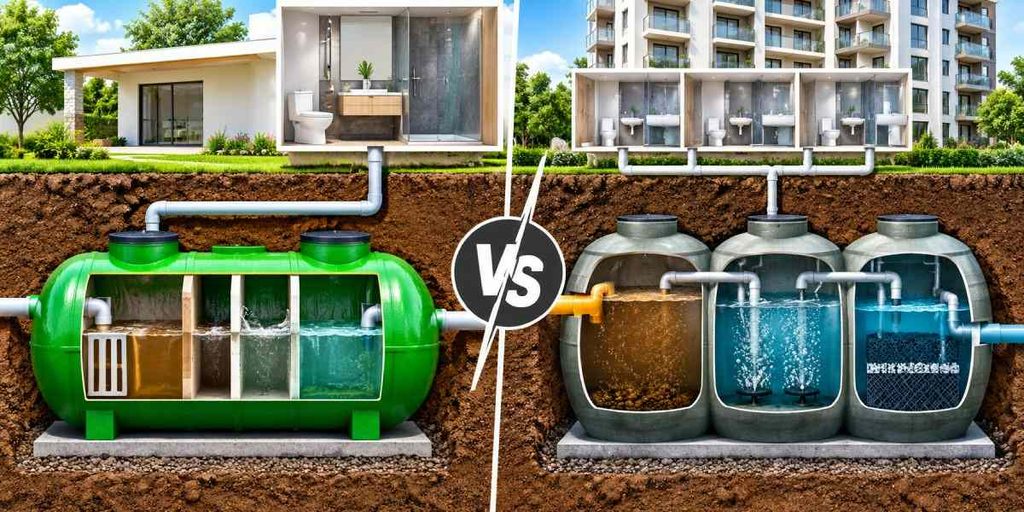
A sewage treatment plant (STP) uses oxygen, pumps, and blowers to treat wastewater, and it usually reuses the water for gardening or flushing. A bio septic tank is simpler, with no power and little upkeep.
| Factor | Bio Septic Tank | STP |
|---|---|---|
| Power use | None | Required |
| Operator needed | No | Often yes |
| Space | Compact | Larger |
| Upkeep | Low | Higher |
| Best for | Small to mid-size buildings | Large complexes |
Larger developments may need an STP under local rules. Confirm requirements with your builder or the relevant authorities, such as TNPCB and CMDA, before you finalise a design
Why FRP Suits Apartment Buildings
A shared tank has to survive years of heavy use. FRP (fibre-reinforced plastic) handles that well:
- Corrosion-proof: Acids and alkalis in wastewater can’t degrade it
- Leak-proof: A one-piece moulded body leaves no joints to fail
- Lightweight: Quicker installation and less stress on the pit
- Ageing-resistant: It doesn’t rot, rust, or flake
Curious about service life? Read our guide on how long a biodigester lasts.
What to Check Before You Buy
- Has the manufacturer sized the tank after visiting your site?
- What material and wall thickness does the tank use?
- Does the design follow IS 18150:2023, India’s code of practice for biodigesters?
- Does the quote include installation, plumbing, and the soak pit?
- Is GST included?
- Is the warranty written down?
- Who handles after-sales service?
- Can the tank take future load if more flats are added?
For a wider shortlist, see our guide to bio septic tank manufacturers in Chennai.
Cost: What Shapes the Price
GGBE bio septic tanks start at ₹45,000. For apartments, the final figure depends on:
- Tank capacity and number of units
- Material and wall thickness
- Excavation, soil condition, and water table
- Pipe distance and outlet arrangement
- Transport and installation
Ask for an itemised quote, so you can compare offers fairly.
Installation: What to Expect
- Site survey and sizing
- Excavation
- Bedding and placement of the tank
- Inlet, outlet, and vent plumbing
- Soak pit or discharge line
- Backfilling and bacterial activation
- Handover with paperwork
Plan the work with your association before you start. Digging across parking areas or driveways affects every resident.
Maintenance Tips for Residents’ Associations
A shared tank needs shared habits. Pin these rules in the notice board:
- Use mild cleaners and avoid bleach and acid-based products
- Never flush wipes, sanitary products, or plastic
- Keep cooking oil out of the drains
- Fix leaking taps and running toilets quickly
- Book a yearly inspection
- Desludge as your supplier advises
If bacteria powder comes up in the meeting, our post on why bacteria powder is needed explains when it helps.
FAQs
Can a bio septic tank serve an entire apartment building?
For small to mid-size buildings, yes, provided the tank is sized correctly. Larger complexes may need multiple units or an STP.
How many flats can a 5,000 litre tank serve?
A 5,000 litre tank suits about 20 to 25 users. The number of flats depends on how many people live in each one.
Is a bio septic tank better than an STP for flats?
It depends on size. Bio septic tanks win on simplicity and running cost, while STPs suit very large developments.
Who maintains the tank in an apartment?
Usually the residents’ association, with a yearly inspection by the supplier or a technician.
Do we need approvals?
Rules vary by building size and location. Check with your local body, TNPCB, and CMDA where relevant.
Final Thoughts
For small to mid-size apartment buildings in Tamil Nadu, an FRP bio septic tank offers a quiet, low-maintenance answer to a loud problem. Get the size right, insist on quality material, and agree on simple habits as a community. The result is fewer tanker visits, fewer complaints, and a building that smells like home.
Ready for a proper recommendation? Talk to the GGBE team for a site visit and an itemised quote.